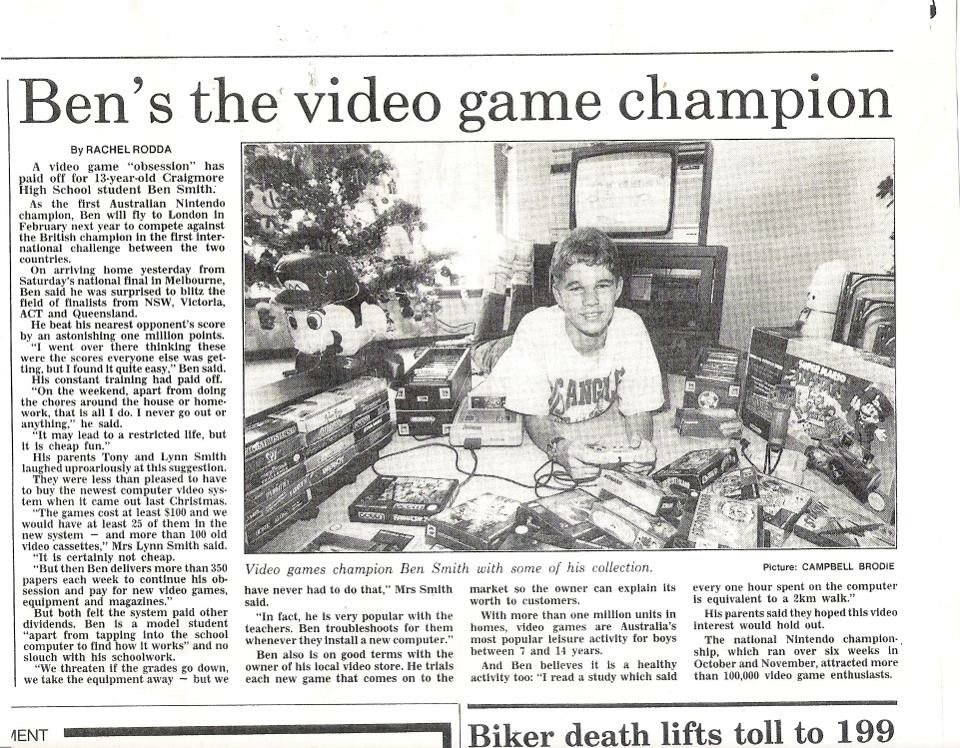
My love of computing began early. After I won the 1993 Super Nintendo Championship for Australia, my mother famously told Seven Nightly News that, as a baby, she would hand me a calculator instead of a rattle so she could shop in peace. I loved numbers and the pure logic a calculator provided. No grey area; the result was the result.
In 1987, I went to a friend’s house and saw their family’s Commodore 64. I was mesmerised. They had the newer C64C, complete with multiple floppy drives and cases full of disks, and to me it felt like I was looking at the future. Not long afterwards, Mum and Dad bought our family a Commodore 64 as well. Even getting it home became part of the family story: growing up in Elizabeth could be unpredictable, and the computer arrived with a memorable lesson in resilience. To save money, ours came with a datasette instead of floppy drives, but I was thrilled nonetheless.
Looking back, that slower machine taught me something valuable. Loading a game from tape could take half an hour, and even then there was no guarantee it would work. If it crashed during the loading process, you started all over again. Sometimes you would wait all that time for only ten or twenty minutes of play. But that inconvenience turned out to be a gift. Rather than sit there waiting, I started to use the computer differently. I wrote my own programmes. I copied code from magazines. I borrowed books from the library and typed out listings line by line. I was not just consuming technology, I was learning to create with it. In many ways, that is what I think is missing for some children today. They are often given technology primarily as a tool for consumption, rather than being shown how it can become a tool for creation.
That instinct to create stayed with me.
After doing some network administration at my old high school, my first proper role in IT was developing a sales database for Target Australia. I had very little guidance. It was just me and the State Manager of Target, with his requirements and my determination to build something useful. The role continued to grow because each iteration produced new operational value. With limited access to technical mentoring or online resources, I learned to test ideas carefully, listen to users and keep improving the system. It was built to help track sales, forecast purchasing requirements, and plan for peak trading periods, especially Christmas. I spent twelve months in that role and learned a great deal, but it was also the 1990s, when demand for technology professionals was intense. While studying, I found myself working three IT jobs, and before long I made the decision to start my own ICT consultancy.
The business was progressing, but the technology economics of the time limited what many smaller organisations could implement. I wanted exposure to larger transformation programs, so I moved into enterprise, defence and later NEC Australia, where I became National Solutions Manager. There I had the opportunity to work on exciting and meaningful projects, particularly in the Northern Territory, including biometrics initiatives that were world leading at the time and helped move the industry forward.
When I look back, my life and career has followed a remarkable arc. It began with a calculator in my hand, moved through low level coding and database design, and eventually carried me into leadership and executive management. Following organisational change at NEC in the mid-2010s, I returned to consulting. In hindsight, that transition opened a valuable new stage of my career.
By then, the technology landscape had changed. What had once been out of reach for small business had become accessible. Cloud platforms, modern software, and digital tools meant smaller organisations could finally afford the systems they needed. What they lacked was not access, but guidance. They needed someone who understood both the technology and the business, someone who could help them implement it properly. That is where I found renewed purpose.
Now we are living through another profound shift: the rise of artificial intelligence.
Many people see AI and feel uncertainty, and that response is understandable. It is reshaping roles, automating routine tasks and prompting organisations to reconsider how reporting, administration and analysis are performed. I see an opportunity to redesign work thoughtfully: reducing avoidable effort while protecting judgement, accountability, development pathways and the contribution of people whose roles are changing.
I see the chance to free people from the mundane so they can spend more time on what actually matters: thinking, creating, solving problems, and building things that make a difference.
At the age of seven, I became a coder. At the age of forty five, nearly four decades later, I have returned to the core of what I enjoy most about computing. This time, however, I return with something I did not have as a child: decades of business experience, hard won perspective, and a head full of ideas. The difference now is that AI allows me to execute those ideas faster than ever before. AI-assisted tools now let me test and refine ideas earlier, before committing a larger delivery team or lengthy development cycle. That produces clearer prototypes, better conversations with specialists and faster evidence about what is worth pursuing. I can prototype, refine, and build with a speed that would once have seemed impossible.
That does not mean the fundamentals no longer matter. In many ways, my early grounding in how computers really work, from typing code manually to understanding the principles beneath the surface, has become even more valuable. It allows me to work with AI as a tool, not be led by it blindly. I can direct it, challenge it, and shape it towards outcomes that are useful, practical, and meaningful.
This for me, is the real excitement of this moment.
I no longer have to choose between creativity and execution. I can turn an early idea into something tangible, then bring clients, specialists and decision makers into the conversation with a clearer shared reference point. I can build, test and solve problems directly while still applying the governance and collaboration that make solutions durable.
I now find myself developing new applications to address niche challenges, some commercial, some practical, some simply because they are interesting and worth exploring. In many cases, if a problem frustrates me, it is likely frustrating others too. That makes it worth solving.
I do wonder what this means for the next generation. I had the benefit of learning from the ground up, of understanding machines at a deeper level because I had to. Will younger people miss out on that foundation because AI abstracts so much away? Or will they surpass us precisely because they are not burdened by old assumptions? I suspect the answer may be both. Every generation builds differently, and perhaps that is exactly as it should be.
What I know for certain is this: in the past twelve months alone, AI has advanced at an extraordinary pace. Tasks that might once have taken me a month in 1998, and a week in 2025, can now sometimes be completed in an hour in 2026. That acceleration is not theoretical, I am living it. And it is changing what one person can achieve.
The point of this story is simple. I fell in love with computers because I love to create, and because I have always been drawn to their logic, their clarity, and their honesty. I have been fortunate to keep creating throughout my career, although leadership responsibilities sometimes moved me further from hands-on experimentation. AI-assisted tools have reopened that creative space while allowing me to bring executive experience, governance and commercial judgement to the work.
Now, in this new era, I feel as though I have come full circle. I have returned to the joy that started it all. Not just using technology, but building with it. Not just managing ideas, but bringing them to life.
For me, that is what computing has always been about. Creation, curiosity, and possibility.
I believe the most exciting part is that I am only just getting started. I am riding this crest of AI at a time when it is reshaping what is possible for people who know how to think, create, and adapt. Yes, it is confronting. Every truly transformative shift is. But there is something deeply human about stepping towards the things that challenge us most, learning them, mastering them, and then using them to build something worthwhile. The printing press was once seen the same way, as a threat to jobs and as a force that would place information into the hands of the masses. Ironically, the printed press itself now seems to be nearing the end of its own era, though I will always miss the experience of reading a physical broadsheet.
I already look forward to sharing these experiences in twenty years’ time with my son, who is only three years old today. No doubt I will try to help him understand how to navigate this world, and whilst I hope my advice is useful, no doubt he will very quickly show me that my advice belongs to another era. That too is part of the cycle. Each generation inherits a new world, and each must find its own way to create value, meaning, and joy within it.
There is a certain poetry in the fact that I found the time to write this while waiting for AI to review my code.