Context
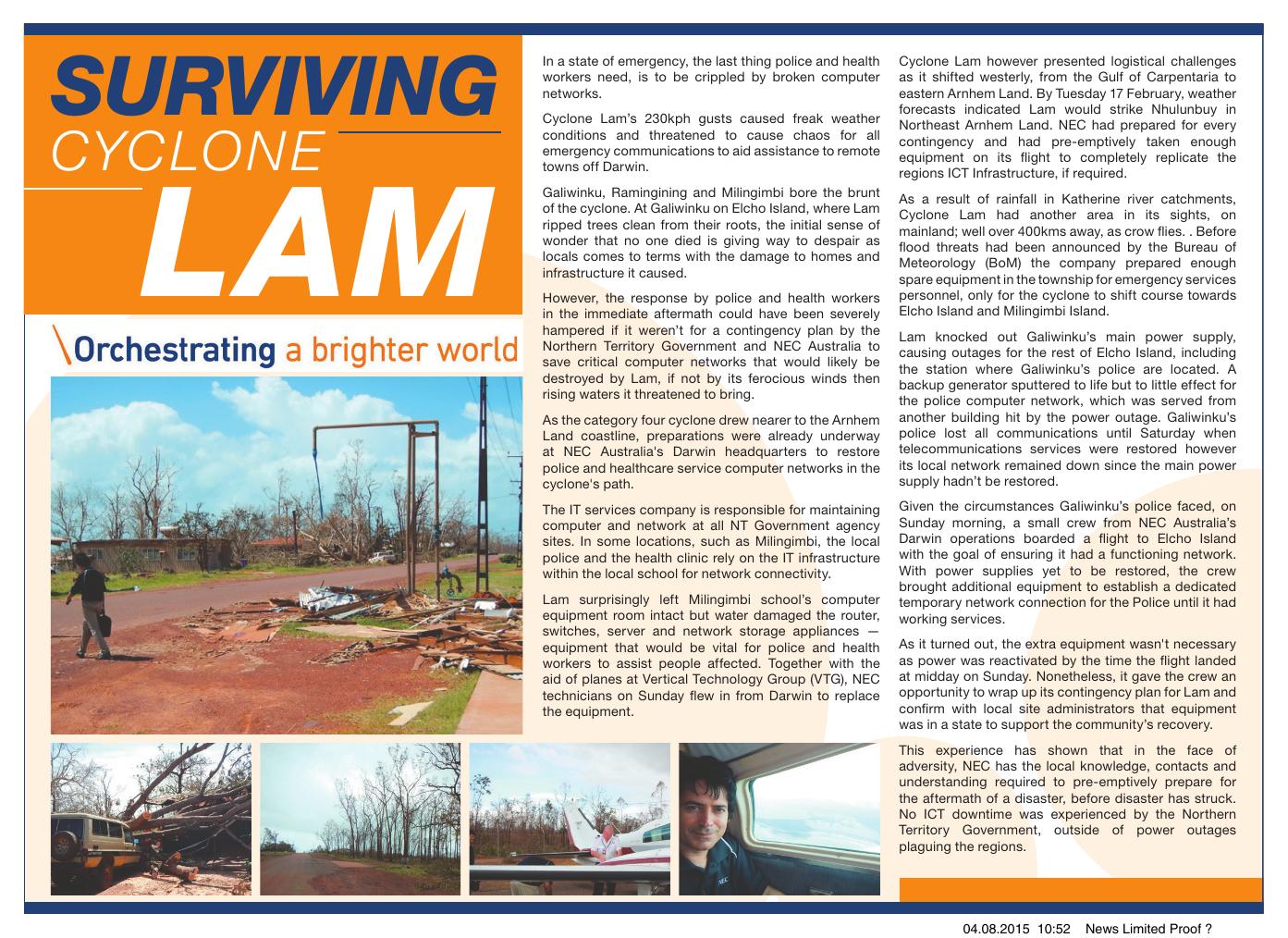
Cyclone Lam was a severe weather event affecting remote Northern Territory communities including Galiwinku, Ramingining and Milingimbi. Police, health workers, schools and other government services depended on working ICT to coordinate response activity, reconnect with central systems and restore normal operations as power and physical access returned.
At NEC Australia, Benjamin was Service Director for End User Computing services to the Northern Territory Government. The work sat inside a long-running managed-services relationship where remote service continuity, public-sector accountability and practical field response mattered.
Problem
Cyclone Lam created a high-consequence continuity problem. Remote communities faced extreme weather, power disruption, damaged facilities, water-affected network equipment and limited transport access. ICT could not be treated as back-office convenience; police and health services needed reliable communications and restored network services to support recovery activity.
The problem was also logistical. Equipment, technicians and replacement infrastructure had to reach remote sites quickly once conditions were safe, and the response needed enough flexibility to restore service even if the damage was worse than first understood.
Benjamin’s Role
Benjamin led the customer-facing service response through NEC’s NT Government managed-services context. His role connected contingency planning, customer communication, service prioritisation, remote logistics, field delivery and recovery coordination.
The response required calm service leadership: understanding which government functions were most dependent on restored ICT, ensuring the right equipment was available, coordinating with NEC teams and partners, and keeping the work focused on practical restoration rather than abstract disaster-recovery language.
What Benjamin Built Or Changed
- Supported pre-event contingency planning for remote NT Government ICT recovery.
- Ensured duplicate communications and network equipment could be taken into the field when access became available.
- Coordinated NEC response activity across affected remote communities and critical government service sites.
- Worked with Vertical Technology Group logistics support so equipment and technicians could reach sites quickly.
- Supported restoration of police, health and government service dependency on network access after power and site conditions allowed work to proceed.
- Maintained customer-facing service discipline across a high-pressure emergency response.
Stakeholders
Northern Territory Government, NT Police, health workers, remote government service sites, affected communities, NEC service and field teams, Vertical Technology Group, school and facility stakeholders, and public-sector executives responsible for continuity and recovery.
Delivery Approach
The approach combined practical disaster-recovery planning with remote-field execution. NEC pre-staged equipment so the response was not limited to a narrow replacement list. The team could respond to the actual damage found on site, including water-damaged network equipment, router, switch, server and storage issues, and temporary network needs.
The recovery model recognised that remote service restoration depends on transport, power, site access, replacement equipment, local conditions and clear customer priorities. It was not enough to wait for a ticket queue; the team had to be ready to move when conditions became safe.
Outcomes
The Northern Territory Government did not experience ICT downtime outside power outages. That outcome mattered because restored ICT allowed police, health and government services to resume effective operations as facilities and power came back online.
The response showed the value of practical contingency planning, local knowledge and partner logistics. By taking enough equipment to replicate regional ICT infrastructure if required, NEC gave the government a stronger recovery posture than a reactive break-fix response could have provided.
The work also strengthened Benjamin’s NEC service-leadership evidence: he could operate across executive accountability, remote logistics, public-sector dependency, vendor delivery and operational continuity during a real emergency.
What It Demonstrates
Emergency ICT response, public-sector continuity planning, remote logistics, service leadership, managed-services discipline and the ability to keep police, health and government service needs central during crisis recovery.