Context
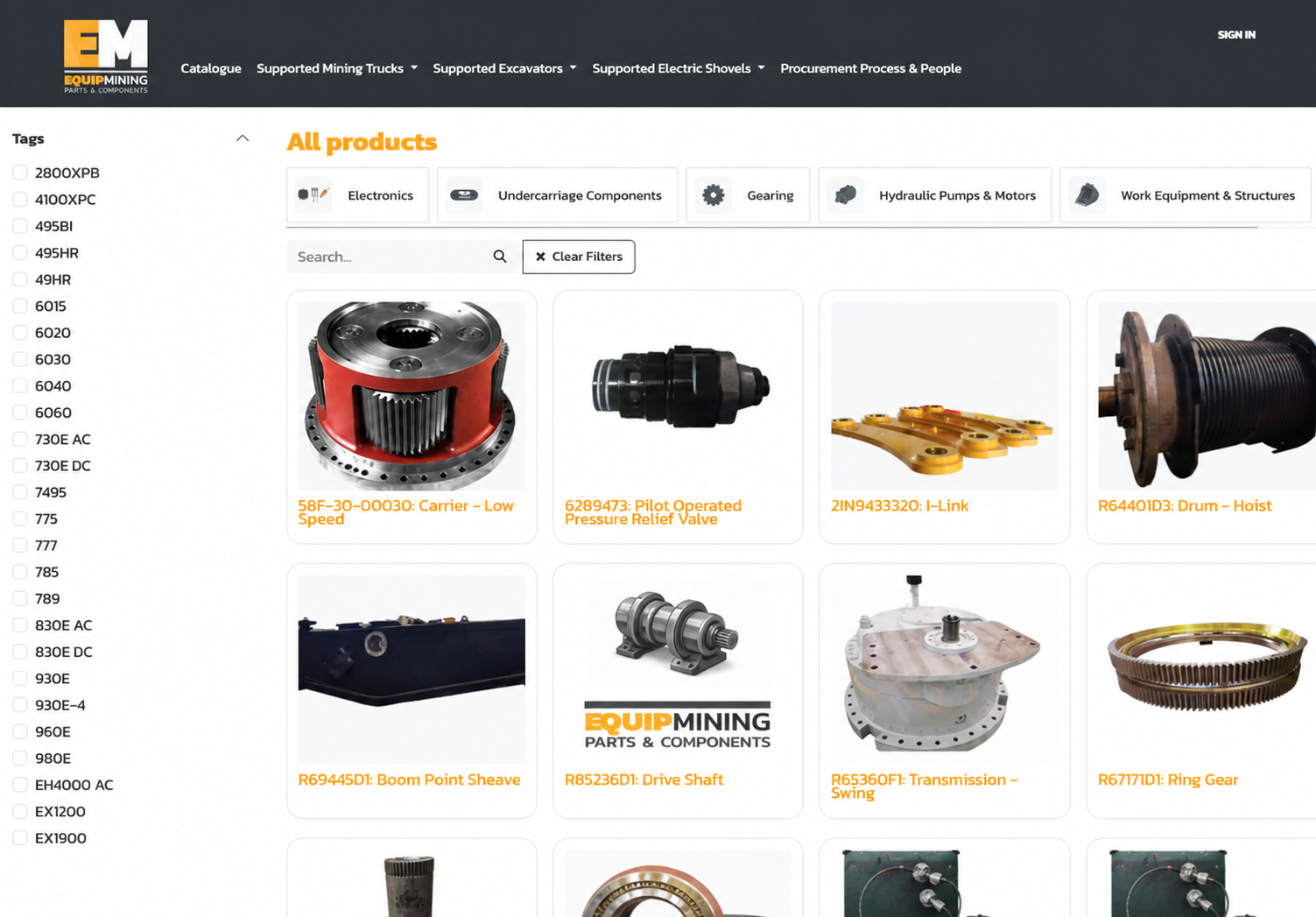
Equip Mining Parts & Components is a mining-equipment parts venture founded by three industry specialists and focused on sourcing quality parts through established international supply channels for Australian customers. The founders contribute specialist parts knowledge, supplier relationships and commercial direction, while Benjamin and Sarah from CXO Advisory contribute business-building and operating-platform capability through an equity-aligned engagement.
The work is not a conventional advisory engagement where a consultant writes a strategy and steps away. It is a hands-on startup build where business model, operating process, product data, supplier workflows, customer workflows and ERP capability are maturing together.
The business requires disciplined product data, supplier response handling, customer RFQ workflows and part-number integrity from the beginning rather than after operations become messy. That matters because mining parts operations can quickly become dependent on informal knowledge, supplier email trails, spreadsheets and individual memory if the operating model is not designed early.
Problem
Mining parts knowledge is often fragmented across supplier emails, spreadsheets, part-number variants, personal memory and informal process. In a startup, that fragmentation becomes expensive quickly. It creates rework, slows RFQ response, weakens customer confidence and increases the need for manual administration before the business has the headcount to absorb it.
The operating challenge is broader than installing an ERP. Equip needs to translate specialist parts knowledge into repeatable workflows for sourcing, supplier RFQs, customer RFQs, procurement, freight logic, product records and target-account activity. The platform also needs to preserve human judgement where it matters: commercial decisions, supplier quality, customer relationship management and data-quality review.
The data challenge is also significant. Mining equipment parts may be known by OEM numbers, replacement numbers, remanufactured numbers, superseded numbers, alternative numbers, informal descriptions and supplier-specific references. Without governance, those variants can undermine quoting accuracy, purchasing confidence and future reporting.
Benjamin’s Role
Benjamin’s role combines business building, technology architecture and AI-assisted ERP product ownership through CXO Advisory, working alongside the venture’s three founding partners. Together with Sarah, he is converting the startup’s commercial intent and specialist parts knowledge into a practical operating system.
The role combines startup support, business analysis, Odoo ERP design, workflow architecture, data governance, AI-assisted development, documentation and implementation troubleshooting. Benjamin is shaping the operating model and system design together so sourcing, RFQs, product integrity, supplier workflows, customer workflows and target-account management are embedded from the start.
The equity-aligned model creates long-term accountability for durability, operating cost, maintainability, data quality and future scale. Benjamin and Sarah’s contribution is therefore measured not only by implementation activity, but by the quality of the operating capability being established.
What Benjamin Built Or Changed
- Odoo ERP foundations for supplier RFQs, customer RFQs, procurement and product data.
- Product and part-number integrity for OEM, replacement, remanufactured, superseded and alternative numbers.
- Data-cleansing workflows and enrichment thinking using ZoomInfo-style data and ABR-assisted Australian company matching.
- Target-account management, supplier and customer portal concepts, freight logic and procurement workflow.
- Codex-assisted module development, troubleshooting and documentation.
- Workflow thinking that connects supplier response handling, customer quoting and product-data governance rather than treating them as separate administrative tasks.
- Startup operating-model design so the three founding partners can build around repeatable process instead of relying only on specialist memory.
- Practical review points where AI-assisted development is checked against commercial reality, Odoo behaviour and human data-quality judgement.
System And Operating Design
The build uses Odoo as the operating backbone rather than as a passive contact or product database. The goal is to make supplier and customer work visible, repeatable and easier to govern as the startup grows.
Key operating patterns include:
- Supplier RFQ structures that support enquiry, response capture and procurement follow-through.
- Customer RFQ and quoting concepts that can preserve request context and reduce duplicated handling.
- Product-data structures that can capture part-number relationships, replacement options and supplier-specific references.
- Target-account and customer-development workflows that support Australian resale activity.
- Freight and procurement workflow thinking so landed cost, supplier lead time and fulfilment implications can be considered consistently.
- Data enrichment and matching approaches that help turn external company and supplier information into usable operating data.
- Documentation and troubleshooting discipline so system knowledge does not remain trapped in one person’s head.
Stakeholders
The work involves the three founding partners, Benjamin and Sarah from CXO Advisory, suppliers, target customers, freight providers, future administrative users and future account-management users.
The stakeholder mix is important because the platform has to serve different needs at once. Founders need visibility and commercial control. Suppliers need clear requests and follow-up. Customers need confidence that RFQs are being handled properly. Future staff need workflows they can learn without relying on undocumented startup memory.
Delivery Approach
Benjamin is using a lean builder approach in an active build and operating-system development stage: capture business rules, encode repeatable process in Odoo, validate edge cases through live records, use AI to accelerate coding and documentation, and keep human review over commercial and data-quality decisions.
The approach is deliberately practical. Instead of trying to design every future process upfront, the work turns real startup needs into structured records, workflows and review points. That allows the system to evolve while still building toward a coherent operating model.
AI-assisted tools are used as force multipliers for drafting, coding support, troubleshooting, data-cleaning logic and documentation. The work still depends on human review because mining parts context, customer trust, supplier quality and commercial judgement cannot be delegated to automation.
Outcomes
The venture demonstrates how ambiguous specialist business knowledge can be turned into a repeatable operating platform. Custom Odoo workflows, supplier and customer RFQ concepts, data cleansing, part-number governance, enrichment workflows and Codex-assisted module development are being used to reduce manual administration and make repeatable process visible.
The work is moving Equip from startup intent toward an operating environment where supplier sourcing, customer enquiries, parts data and follow-up can be governed rather than improvised. It gives the founding partners a stronger platform for scale because process, data and system design are being built while the business is still forming.
The public value of the case study is not that an ERP was installed. It is that the operating model, data model and startup build are being developed together under a sweat-for-equity arrangement where CXO Advisory’s contribution is tied to the long-term quality of the business being built.
What It Demonstrates
Startup build leadership, ERP architecture, practical AI use, hands-on implementation, commercial judgement and the ability to convert messy specialist knowledge into governed workflow.