Context
The Police Watchhouse project sat in a justice and law-enforcement environment where speed, identity confidence, privacy, governance and operational usability all mattered. Identification needed to support real custody workflows, not simply demonstrate facial-recognition technology in isolation.
The project formed part of Benjamin’s NEC-era secure-identity work across policing, justice and government environments.
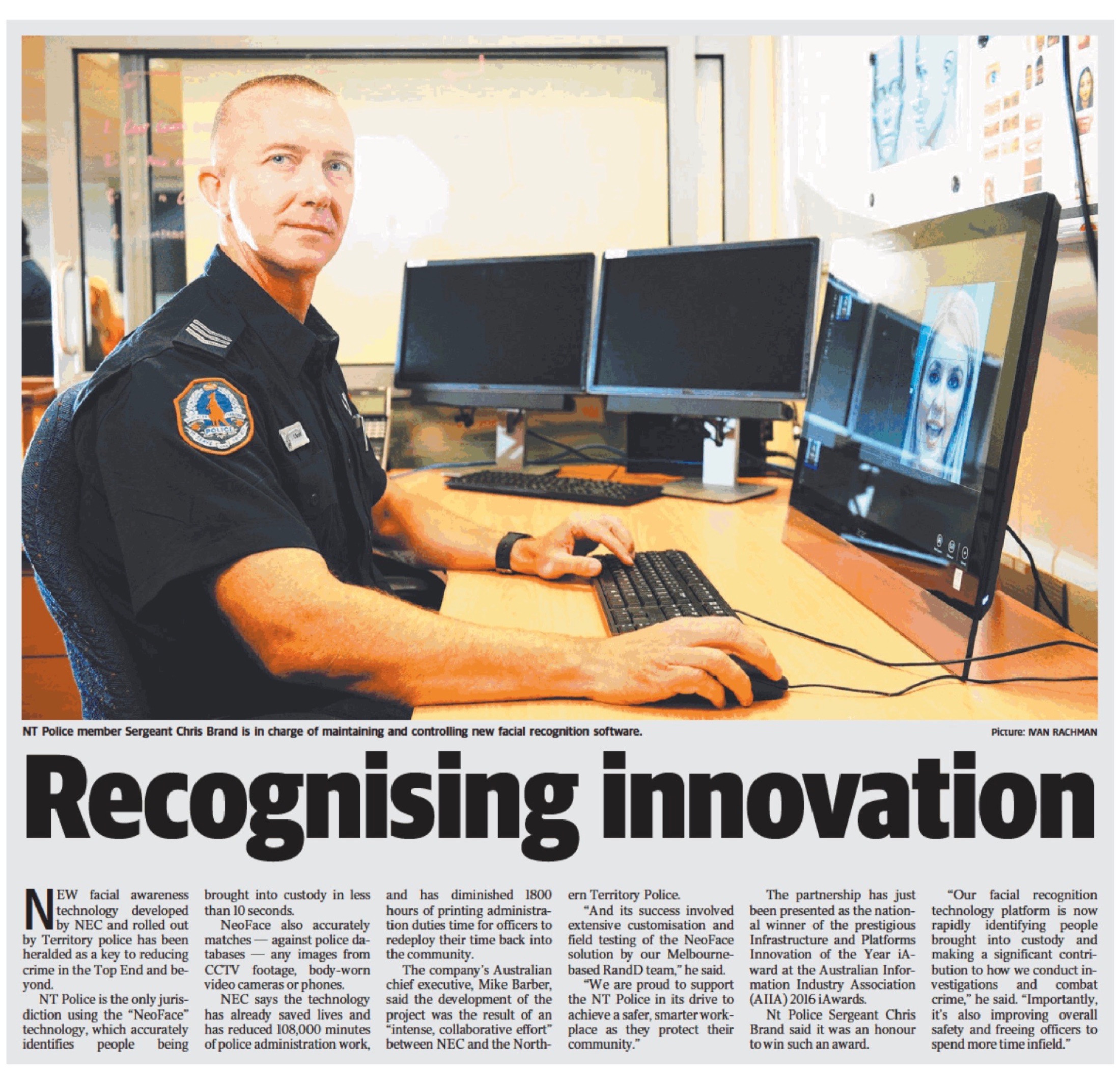
NEC NeoFace technology was customised and implemented with NT Police to support real watchhouse identity workflows. The solution matched approved operational imagery, enabled identification in less than 10 seconds and supported hundreds of operational identifications before broader phase-two use.
Problem
Traditional identification processes can be slow and operationally difficult in custody contexts. Fingerprinting a person in a watchhouse can require close physical handling at exactly the point where the person may be distressed, intoxicated, aggressive, unwell or unwilling to cooperate.
That created significant operational risk. Physical altercations could lead to staff injury, and close-contact fingerprinting also increased concern about exposure to illness or disease. The identity process needed to be faster, safer and less confrontational while still meeting public-sector governance and policing requirements.
The challenge was to improve identity management while staying inside public-sector governance, policing procedures, privacy expectations and operational constraints.
Benjamin’s Role
Through NEC Australia, Benjamin led the vision, business development and project management that connected NT Police stakeholders with the technical teams delivering the solution. His role connected customer need, biometric identity capability, delivery governance, commercial support, operational stakeholders and award recognition.
This was a practical business and delivery role rather than a purely technical proof of concept. Benjamin turned a secure-identity idea into a customer-facing solution path that could be explained, governed and delivered.
What Benjamin Built Or Changed
- Framed the watchhouse identity problem as a governed operational workflow, not a technology demonstration.
- Drove facial-recognition-oriented identity management for faster and lower-contact identification of persons of interest in custody contexts.
- Positioned facial recognition as a practical way to reduce reliance on high-contact fingerprinting in watchhouse conditions.
- Connected NeoFace Reveal facial-recognition capability with real watchhouse workflows, including photo, CCTV, body-worn camera and phone-image matching.
- Connected public-sector stakeholders, operational users, NEC delivery teams and biometric technology capability.
- Progressed the work from concept and proof-of-capability thinking into a recognised public-sector innovation project.
- Focused the solution narrative on staff safety, operational value, governance and public-sector delivery discipline.
Stakeholders
Police, custody and watchhouse stakeholders, public-sector executives, justice stakeholders, NEC delivery teams, biometric technology specialists, governance stakeholders and award-recognition bodies.
Delivery Approach
The approach balanced innovation with governance. The project required stakeholder alignment, proof-of-capability discipline, usability in operational settings, technical delivery management and disciplined identity governance.
The operational design was shaped by the human reality of the watchhouse. The solution needed to reduce unnecessary confrontation, support staff confidence and make the identification process more acceptable to people who regularly moved through the watchhouse.
The delivery narrative was anchored in public-sector value: safer staff interactions, faster identity confidence, stronger operational usability and a clearer path for responsible biometric innovation in a high-consequence environment.
Outcomes
The work became one of the strongest public-sector delivery outcomes in Benjamin’s NEC period. It received NT Chief Minister’s Innovation Award recognition, ACS Digital Disruptor Gold Award recognition and National iAwards recognition.
The Watch House Project received national iAwards recognition and, according to published project reporting, redirected approximately 1,800 hours of police administration from lower-value process work.
The project also demonstrated that biometric identity could be framed responsibly for high-consequence public-sector environments when delivery, governance, operational usability and staff safety were treated as core requirements.
The lower-contact identification model was also associated with an 80 per cent reduction in time away from work due to injury or illness. Staff morale improved because the identification process became less physically confrontational and less exposed to avoidable health and safety risk.
Frequent visitors to the watchhouse also preferred facial recognition over fingerprinting, which improved acceptance of the identification process and reduced unnecessary friction between staff and persons in custody.
What It Demonstrates
Secure identity innovation, business development, public-sector delivery, governance-aware biometrics, staff-safety improvement and the ability to project manage technical delivery teams in high-consequence operating environments.